LED lighting in horticulture: three megatrends transforming professional growing
Category: Horticulture
LED lighting in horticulture is no longer simply an alternative to conventional light sources. In high-tech greenhouses, vertical farms and controlled-environment agriculture, light is becoming a measurable, adjustable production variable coordinated with climate, irrigation, CO₂ and plant physiological state.
This also changes facility design. The debate goes beyond which luminaire produces more light or which spectrum to use. Growers need to know how many photons actually reach the crop, their uniformity, the energy cost of a target DLI and the resulting response throughout the cycle.
Professional horticulture also faces urban growth, demand for predictable production, volatile energy prices, pressure to reduce resource use and demand for uniform products almost year-round. Horticultural LED solutions are therefore evolving from static lighting towards control platforms integrated with the facility.
Three megatrends describe this evolution in professional growing.
1. Production closer to consumers, more controlled and more resilient to external variability
The first change concerns the production model, not just lighting. Increasingly urban populations need stable fresh-food supplies, while extreme temperatures, drought, weather events and logistical disruption increase demand for less exposed production systems.
The United Nations notes continuing population growth and urbanisation’s influence on food systems. The FAO also highlights urban and peri-urban agriculture’s potential contribution to resilient city supplies. High-tech greenhouses and vertical farms will not necessarily replace conventional agriculture, but may play increasingly specialised roles in particular crops, regions and supply chains.
LEDs offer production capacity independent of immediate sunlight availability. In greenhouses they supplement insufficient daylight; in vertical farms they can be the main source of photosynthetically active radiation. This improves cycle planning, reduces seasonal differences and supports more consistent lighting conditions.
Protected cultivation can use DLI, or Daily Light Integral: accumulated photosynthetic photons per unit area per day. Instead of considering only operating hours, growers can define a daily dose and supplement available sunlight accordingly.
Lighting thus becomes another controlled greenhouse variable. The aim shifts from simply switching lights on to achieving specified conditions as efficiently as possible.
This is even clearer in vertical farming, where every mole of light must be generated artificially. Luminaire efficiency, distance to crop, uniformity, surrounding reflectance, photoperiod and spectral recipe directly affect crop economics.
At Neocultum, we address these interactions in our horticultural LED solutions for protected and vertical systems.
2. From luminaire efficiency to the energy efficiency of the whole crop
The second trend changes how efficiency is understood. Light-source electrical efficiency has long dominated technology comparisons. It remains fundamental, but is insufficient for a modern installation.
Growers ultimately need to know marketable production per resource consumed by the whole system. Lighting must be related to climate control, dehumidification, ventilation, CO₂, water and nutrition. An extremely efficient luminaire does not guarantee an efficient operation if the recipe increases energy use elsewhere.
Adjustable LEDs enable more precise management. In greenhouses with radiation sensors, supplemental lighting can follow available sunlight to maintain target PPFD or DLI. Rather than fixed schedules alone, the system can increase, reduce or interrupt light according to real conditions.
Research is going further, examining dynamic daily and crop-cycle strategies to use photosynthetic responses and cheaper energy periods more effectively.
A 2024 Frontiers in Science paper on dynamic vertical farming highlights simultaneous changes to intensity, spectrum, lighting pattern and photoperiod alongside CO₂, temperature, humidity, air movement, water and nutrients. The objective is to replace static setpoints with management responsive to changing crop needs.
This is significant: yesterday’s optimal recipe need not be tomorrow’s. Young plants differ in leaf area, photosynthetic capacity and architecture from plants several weeks older. Identical lighting throughout the cycle may be simple without being optimal.
Dynamic management also makes electricity price a potential control variable. Where some daily light dose can be delivered at different times, consumption may shift towards cheaper periods, provided crop physiology permits it.
The benefits of combined automation and energy management are beginning to be quantified. A Nature Food study used modelling and artificial intelligence for joint lighting and climate control in artificially lit facilities, finding substantial energy reductions against conventional strategies in the studied scenarios.
The next technological step may therefore come not just from slightly more efficient LEDs, but from using every photon more intelligently.
This connects directly with dynamic LED grow lighting, where intensity and recipes change with cycle stage and agronomic objective.
3. Light becomes a tool for quality, uniformity and commercial value
The third trend changes the traditional concept most strongly. Lighting historically supplied enough energy for photosynthesis and higher production. LEDs add another dimension: using light composition and timing to influence plant characteristics.
Spectrum can affect morphology, leaf expansion, pigmentation, elongation, architecture and metabolism. Responses depend heavily on species, cultivar, intensity and environment, so there is no universal recipe. The value is not simply more red, more blue or visually whiter light, but selecting and validating a combination for a specific objective.
This matters where commercial quality is as important as, or more important than, biomass. Leafy vegetables may require compactness, colour or particular compounds; herbs may prioritise aroma, morphology or shelf life; fruit crops add uniformity, sensory characteristics and post-harvest behaviour.
Scientific evidence cautions against simple claims. Our analysis of blue light in basil found that sharply increasing blue did not automatically improve antioxidants or storage performance. Total intensity could instead matter depending on cultivar and objective.
The same principle applies elsewhere: lighting belongs to a complete growing recipe. Temperature, humidity, CO₂, nutrition, water and intensity continually interact with plant physiology.
This shifts horticulture from yield alone towards consistency. Supermarkets, distributors and growers value products maintaining similar specifications across different months.
Artificial light does not remove biology or make plants perfectly predictable industrial processes, but it reduces a major source of variability: light availability.
The next step: lighting, sensors and agronomic control as one system
These trends converge. Advanced horticulture increasingly treats lighting, climate and crops as interconnected components: decisions about one variable change the needs of others.
Light affects leaf temperature and water demand; temperature influences metabolic rates; humidity changes transpiration; CO₂ changes photosynthetic response; leaf area determines how much radiation is intercepted. Optimising one variable alone may shift a problem elsewhere.
PAR sensors, climate control, adjustable luminaires, management platforms, predictive models, machine vision and chlorophyll fluorescence are therefore gaining importance. Research in 2026 already uses plant physiological information to adjust supplemental lighting rather than relying only on fixed setpoints.
Dynamic control does not mean every operation needs AI or complex infrastructure. It means lighting should support measurement, adjustment and learning. Even simple installations benefit from correct PPFD, DLI and uniformity measurements before choosing operating strategies.
Agronomic knowledge remains essential. Greater adjustability increases the need to understand what to change, when and why.
Why are LEDs particularly suited to this horticulture?
Their importance goes beyond lower electricity consumption than older technologies. Their strategic advantage combines efficiency, dimming, spectral control, instant response and digital integration.
Light can thus become part of agronomic management rather than a fixed condition. Greenhouses can dynamically supplement sunlight; vertical farms can construct almost their entire light environment. Both can examine photons used against commercial outcomes.
Selection criteria must also change. Watts or installed power alone reveal little. Professional projects should assess photon efficacy, PPFD distribution, uniformity, target DLI, dimming, crop architecture, canopy distance, interaction with sunlight where present and expected crop response.
Energy costs remain a major constraint. Research notes that fully indoor systems remain energy-intensive, making joint lighting and climate optimisation essential. That pressure also accelerates more efficient solutions and advanced controls.
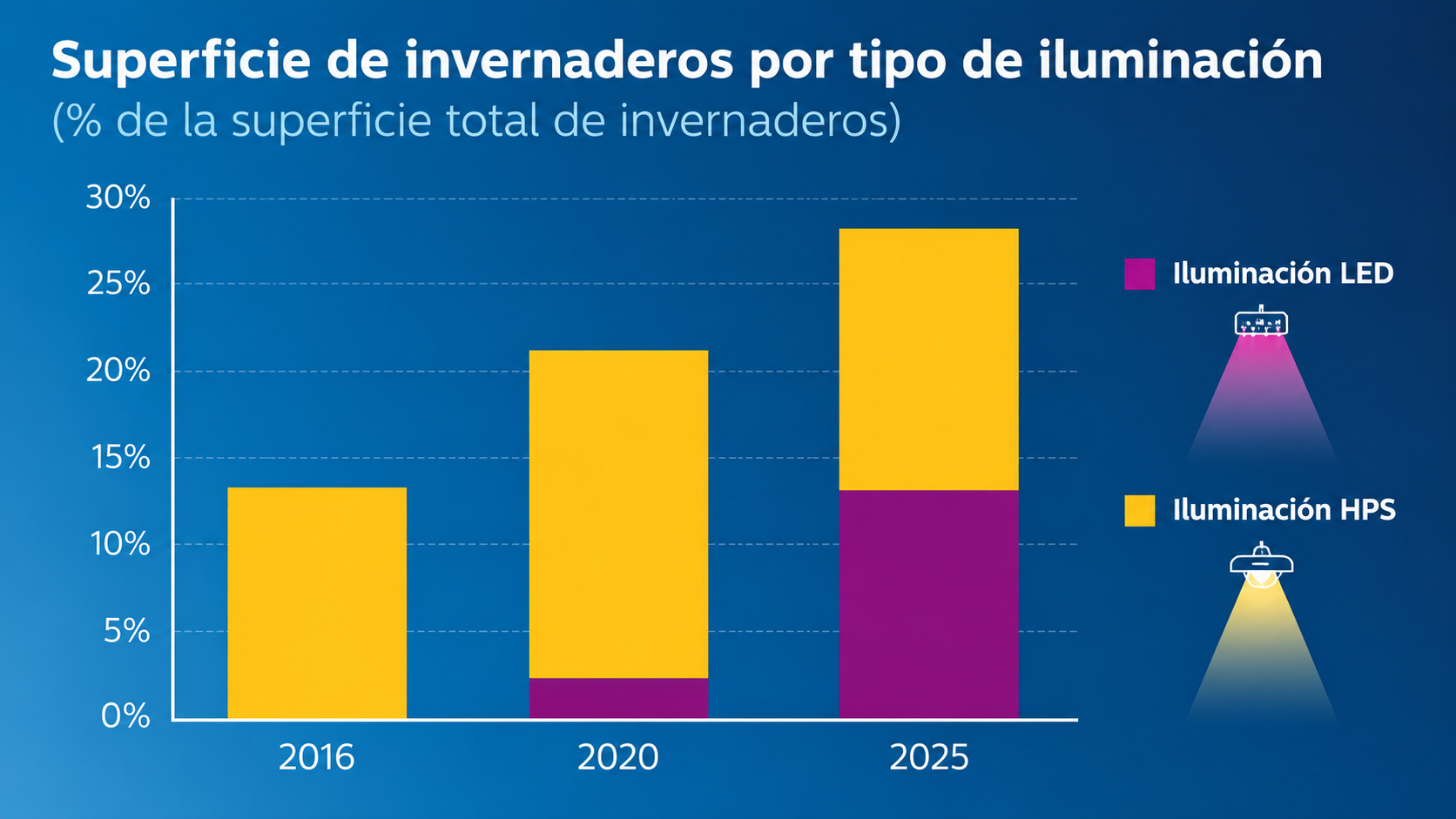
LED lighting is more than a light source
The three trends transforming horticultural LED lighting—controlled production close to consumers, energy optimisation and more precise quality control—all require better measurement and resource management.
The immediate future is not simply more luminaires, but determining how much light each crop needs, when, how it should be distributed and how it should interact with the environment to maximise value per unit of energy.
Greenhouses and vertical farms increasingly connect light, climate, physiology and economics. Lighting is changing from relatively static photon supply into an active tool for production, quality and efficiency.
Growers designing facilities should therefore select LEDs from an agronomic as well as electrical perspective, considering crop, installation, production objectives and control strategy as a single project.
At Neocultum, we offer professional horticultural LED solutions for greenhouses, vertical farming and other controlled systems. For new or existing facilities, contact our team to examine light distribution, LED technology and crop-specific requirements.