Precise control of LED spectrum has made light a true agronomic variable in vertical farms. For high-value crops, research goes beyond providing enough photons for photosynthesis to examine whether spectral regions can modify morphology, stimulate secondary metabolites or improve post-harvest quality. Blue light in basil illustrates why responses must be studied for each species rather than extrapolated from other crops.
Blue radiation covers approximately 400–500 nm and participates in photosynthesis and plant signalling. Its relationship with phenolic, flavonoid and anthocyanin synthesis has prompted interest in whether increasing its spectral fraction can raise antioxidant concentrations or improve resistance to post-harvest stress. This is commercially relevant to basil, which is sensitive to chilling injury and leaf blackening.
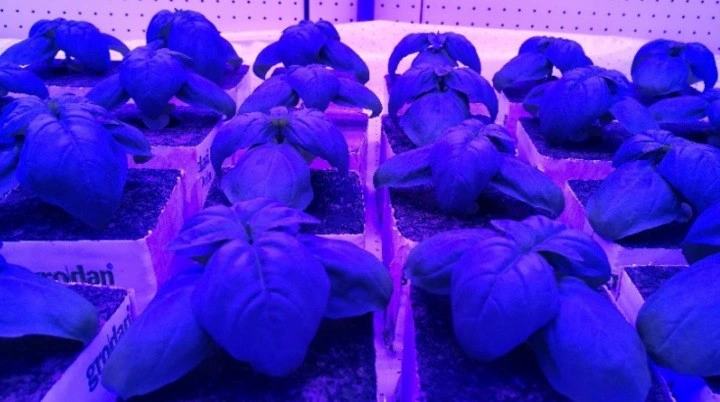
Researchers from Wageningen University & Research and Signify tested this hypothesis in green and purple basil. Their findings challenge an oversimplified interpretation of horticultural lighting: substantially increasing blue light did not generally improve antioxidant capacity or chilling tolerance.
Why blue light is physiologically interesting
Phenolic compounds are part of secondary plant metabolism and help protect against stress. They include flavonoids, anthocyanins and phenolic acids. Rosmarinic acid is particularly relevant in basil: a characteristic metabolite of several aromatic species and an antioxidant commonly assessed in biochemical crop-quality studies.
The hypothesis is reasonable: if more blue radiation stimulates certain metabolic pathways in some species, a pre-harvest spectral treatment might increase antioxidants and potentially improve tissue resistance to deterioration. This is attractive in vertical farms, where spectrum, intensity and photoperiod can be reproduced or modified independently of sunlight.
However, responses depend on species, cultivar, total intensity and treatment timing. The interaction between spectral quality and photon quantity is central to the basil experiment.
What role does blue light play in plants?
Plants use blue radiation both for photosynthesis and to regulate physiological processes.
LED lighting allows precise selection of spectral regions, changing the blue fraction relative to other wavelengths and studying crop responses. Blue light is associated with:
- plant morphology;
- leaf development;
- stomatal opening;
- pigmentation;
- production of particular metabolites;
- environmental responses.
These responses are not identical across species. A recipe that works well for lettuce need not produce the same results in basil.
Experimental design: blue percentage, PPFD and end-of-production treatment
The study used two approaches to separate blue-light proportion from total photosynthetically active radiation. First, green cultivar Dolly received spectra containing 9, 33, 65 and 100% blue light. Treatments were applied either continuously during development or during the final five days before harvest as an End-of-Production (EOP) treatment.
EOP is relevant to production because adjustable lighting can temporarily change the spectrum in the final days, rather than changing the entire cycle. The aim is to induce a particular metabolic response without necessarily accepting the energy cost or morphological effects of that spectrum throughout growth.
A second experiment compared 9 and 90% blue EOP treatments at photosynthetic photon flux densities (PPFD) of 100 and 300 µmol·m⁻²·s⁻¹, using green Dolly and purple Rosie. This tested both metabolic responses to blue proportion and interactions with total intensity.
Spectral percentage alone does not fully describe a treatment: 90% blue at 100 µmol·m⁻²·s⁻¹ gives a very different absolute blue-photon dose from 90% at 300 µmol·m⁻²·s⁻¹. Professional comparisons must distinguish spectral composition, PPFD and daily light dose.
Antioxidants and metabolites: more blue caused limited changes
The researchers analysed rosmarinic acid, total ascorbic acid, flavonoids and anthocyanins to establish whether high blue fractions caused a clear biochemical response. Contrary to the initial hypothesis, blue percentage had limited effects on these compounds at harvest in both green and purple basil.
Notably, rosmarinic acid did not consistently increase. Nor was there a significant, generalised anthocyanin increase justifying very high blue percentages as a universal quality strategy. There was also no significant interaction between blue proportion and tested PPFD levels for the main antioxidants.
This is more informative than simply saying blue light does not work. Blue remains physiologically active and part of a normal basil recipe. The trial questions sharply increasing its share specifically to boost antioxidants or post-harvest quality.
A wavelength having physiological effects does not mean that increasing its proportion necessarily produces a proportional agronomic response. This distinction matters because every spectral change affects lighting design and overall efficiency.
Cold storage: intensity mattered more than blue percentage
The post-harvest analysis was particularly interesting. Basil is sensitive to cold and can develop dark necrotic areas at excessively low storage temperatures. Plant material was stored at 4 °C and 12 °C to assess antioxidant losses and physiological indicators of chilling injury.
Antioxidants declined during storage, more strongly at 4 °C. Increasing pre-harvest blue percentage did not significantly protect against chilling injury. Tolerance was assessed through necrotic areas and Fv/Fm, a chlorophyll-fluorescence parameter used to assess photosystem II function.
The most interesting result concerned purple basil. Plants grown at the higher PPFD showed greater chilling tolerance regardless of blue percentage. Researchers linked this to higher leaf soluble sugar and starch levels under stronger light. Within the tested conditions, total light quantity more clearly influenced some post-harvest tolerance characteristics than the blue spectral fraction.
Practically, assessing spectrum alone can give an incomplete picture of quality. Plants respond to intensity, spectrum, photoperiod, temperature, humidity, CO₂, nutrition and physiological state. A professional growing recipe must consider these as one system.