The ideal temperature for growing basil: improving growth, yield and shelf life
Category: Vertical farming
Temperature is one of the factors with the greatest influence on basil growth rate, productivity and post-harvest shelf life. In a vertical farm or indoor growing facility, temperature control is particularly important because it creates stable conditions throughout the year.
However, raising temperature does not necessarily produce a better product. Basil may grow faster under certain warm conditions, but this can be accompanied by a shorter post-harvest life. Optimising indoor basil therefore requires a balance between temperature, LED lighting, humidity, nutrition, CO₂, photoperiod and other environmental parameters.
This article examines why temperature matters and how to combine climate control with a suitable LED light recipe for efficient production adapted to the product’s commercial destination.
Why is basil well suited to vertical farming?
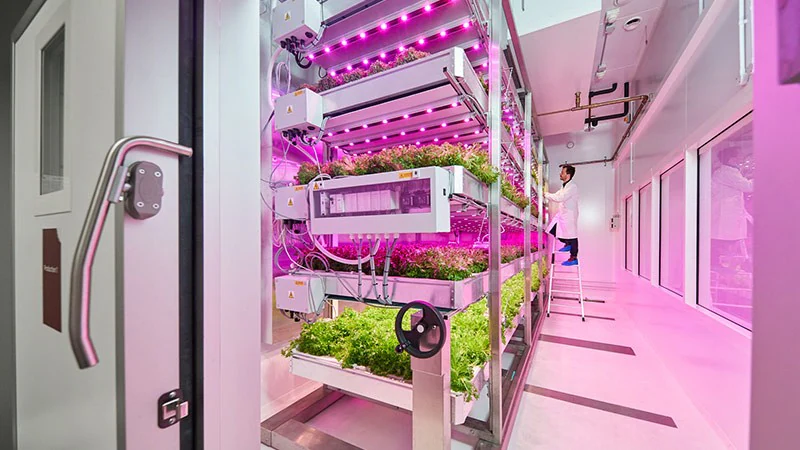
Basil is one of the most interesting herbs for vertical farming. Its size, production cycle and commercial value make it particularly suitable for indoor systems. Plants can be arranged on multiple levels and grown hydroponically using different substrates. Independence from direct sunlight also enables year-round production cycles.
The installation must provide the necessary environmental conditions, including temperature, humidity, nutrients and horticultural LEDs. At Neocultum, we work with LED lighting for horticulture and vertical farming that adapts spectrum, intensity and hours of light to different plants and development stages.
What is the ideal temperature for growing basil?
A single ideal temperature is an oversimplification. The appropriate temperature depends on variety, growth stage, environmental conditions and, especially, the final production objective. Basil intended for food processing need not use the same strategy as fresh basil that must retain its appearance during storage, transport and sale.
Vertical farming trials have studied this relationship between temperature, productivity and shelf life. Experiments with different basil varieties used temperatures from 22 to 30 °C. Under the tested conditions, increasing temperature increased productivity expressed in grams per mole of light, but also shortened shelf life.
The trial is described in Philips’ technical article on temperature effects in basil growth.
Higher temperature can mean faster growth
Temperature directly influences many physiological processes. Within a suitable range, changing it can alter crop development rate. Faster growth is attractive to growers: reaching harvest conditions sooner can potentially optimise production cycles.
In vertical farming, where every square metre and growing level contributes to the economic model, production speed is important. But producing faster is not the same as producing better. Yield must be assessed alongside the quality basil retains after leaving the facility.
Balancing basil growth and shelf life
Basil that grows quickly but loses quality soon after harvest may not suit certain commercial models. Shelf life is particularly important for fresh basil.
After harvest, leaves must retain marketable characteristics. Logistics, storage and the time needed to reach consumers make preservation fundamental to profitability. Production temperature should therefore account for what happens after harvest.
Basil for pesto and fresh basil: different objectives
Production for pesto and production of fresh-cut basil offer a useful comparison.
When raw material will be processed quickly, maximising growth can be very important, and long post-harvest storage may matter less. Fresh basil, by contrast, requires greater attention to shelf life. Growers must balance:
- growth rate;
- yield per unit area;
- energy consumption;
- leaf quality;
- crop uniformity;
- post-harvest shelf life.
This explains why no single growing recipe is necessarily perfect for every installation.
Temperature does not act alone
One mistake in analysing indoor growing is studying each parameter independently. Plants respond simultaneously to temperature, light, humidity, CO₂ availability, water, nutrients and substrate characteristics, all within one system.
Knowing the appropriate temperature is only part of the task. Efficient cultivation requires understanding its interactions with other variables. This integrated approach leads to the concept of a growing recipe.
What is a basil growing recipe?
A growing recipe is a controlled combination of parameters intended to achieve particular plant characteristics. For indoor basil, variables include:
- ambient temperature;
- relative humidity;
- CO₂ concentration;
- nutrition;
- hydroponic system and substrate;
- light intensity;
- light spectrum;
- photoperiod;
- planting density;
- harvest timing.
The objective is to obtain the desired characteristics while using resources efficiently.
Temperature and LED lighting must work together
LED lighting is a primary tool for controlling plant development in vertical farms. Light quantity, spectrum and operating hours can match crop needs, but the response does not depend on the luminaire alone.
The plant uses light energy within particular environmental conditions. A professional strategy must therefore consider light and climate together. Seeking an extremely precise light recipe while ignoring temperature would make little sense. Combining LEDs and climate control enables more complete indoor herb production strategies.
How does the light recipe influence basil?
A light recipe determines how plants are illuminated during development. Its main parameters are spectrum, intensity and photoperiod. Changing them adapts lighting to crop stages and desired characteristics. This is especially useful in vertical systems, where growers have considerable environmental control.
Instead of relying on changing solar radiation, repeatable lighting conditions can be established across production cycles. Neocultum offers vertical farming and horticultural LED solutions focused on intensity control and professional light recipes.
Do more light and heat always produce more basil?
This is not the right approach. A professional installation should not maximise every variable, but find the point where the complete system delivers the intended commercial result.
Greater production may become unattractive if energy consumption rises too much, quality declines or shelf life falls substantially. Optimisation is therefore more useful than simple maximisation. Controlled-environment agriculture makes it possible to seek this balance.
Basil variety also matters
Basil cultivars differ in colour, aroma, morphology, growth rate and commercial characteristics. Genovese, Thai, lemon basil and other varieties can respond differently to identical conditions.
A recipe developed for one variety should not automatically be transferred to another without testing. Professional projects should consider the selected genetics, commercial destination and production conditions together.
Why do vertical farms offer better control?
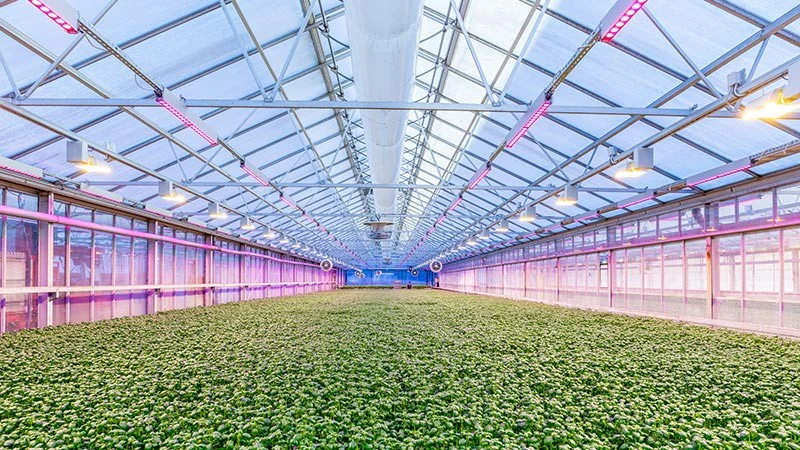
A vertical farm isolates much of production from outdoor fluctuations. In a controlled environment, temperature can remain within defined targets and artificial lighting can be precisely programmed.
This supports year-round production and repeatability between cycles. Repeatability helps commercial growers obtain a more uniform product and determine which changes genuinely improve results.
Energy costs are also part of the recipe
Temperature and lighting both relate to indoor energy consumption. A professional recipe must therefore be assessed economically. It is not enough to identify the conditions producing the most biomass: the required resources and the final product’s commercial value also matter.
A well-designed installation balances productivity, quality, shelf life and efficiency. LEDs are particularly useful because they provide precise control and adapt operation to each crop.
Can we grow quickly and preserve quality for longer?
This is an important vertical farming research question. If conditions favour rapid growth but shorten subsequent shelf life, one possible strategy is to modify the recipe in the final stages. Pre-harvest treatments allow different conditions during growth and the final days.
Rather than maintaining completely constant temperature and light recipes, control systems enable dynamic strategies. The future of vertical farming may lie in giving plants the right conditions at the right time.
Planning professional indoor basil cultivation
Before defining temperature or selecting a luminaire, determine the intended product. Will the basil be sold fresh or processed quickly? What shelf life is required? Which variety, target yield, energy cost and hydroponic system will apply?
The answers enable a more precise strategy and help define suitable temperature, humidity, nutrition and lighting recipes.
Conclusion: the best temperature depends on the crop objective
Temperature is fundamental to vertical-farmed basil, but choosing only the fastest-growth temperature creates an incomplete strategy. Trials between 22 and 30 °C highlight the balance: under the studied conditions, warmer temperatures were associated with higher productivity but shorter shelf life.
The best recipe therefore depends on the commercial destination. Temperature must be assessed together with LED lighting, spectrum, photoperiod, humidity, nutrition, CO₂ and the remaining growing variables.
Vertical farming controls these variables with precision difficult to achieve in other systems. This can support not just more production, but consistent, efficient basil with the characteristics the market needs.
If you are developing a controlled-environment agriculture project, explore Neocultum’s horticultural LED lighting and light recipes for herbs, vegetables, fruit and vertical crops.