Dynamic LED grow lights: how to optimise a vertical farm

Category: Horticulture

Vertical farming is changing food production. Growing indoors in multiple layers allows producers to control variables that conventional agriculture largely leaves to the environment. Temperature, humidity, CO₂ concentration, irrigation and especially lighting can be adjusted to create suitable conditions for each crop.

In this context, dynamic LED grow lights offer an especially interesting possibility: changing light intensity and spectral composition during the growing cycle to match plant needs. This goes beyond fixed lighting, using different light recipes according to the growth stage or production objective.

Scientific research shows that plant responses to light depend on species, variety, intensity, spectrum and development stage. Dynamic lighting can therefore seek a balance between growth, yield and specific quality characteristics. Recent research on LED lighting in vertical farming highlights the importance of adapting the spectrum to crop objectives.

What are dynamic LED grow lights?

Dynamic LED lights are lighting systems that allow particular parameters of the light supplied to plants to be changed. Depending on the technology, intensity can be adjusted and different spectra or wavelengths combined to create different lighting scenarios.

This differs significantly from a conventional installation where all luminaires operate with fixed settings throughout almost the entire cycle. In a vertical farm, where space and energy consumption account for considerable production costs, adjustable lighting can offer greater flexibility.

LED lighting also enables precise control of the amount of light plants receive without adding the same thermal load as other lighting technologies. Neocultum works with LED solutions for horticulture for greenhouses, hydroponic crops, vertical farms and other indoor production systems.

1. Adapt light to each growth stage

A major benefit of dynamic LEDs in vertical farming is adapting lighting to different crop stages. A young plant does not necessarily have the same needs as one approaching harvest, so maintaining identical conditions throughout the cycle may not be the most efficient strategy.

During early stages, particular light conditions may be prioritised to encourage uniform growth. Later, the strategy can change to pursue objectives relating to size, plant architecture, biomass production or particular quality characteristics.

The relationship between spectrum, intensity and plant development is complex. A scientific review of vertical farming lighting notes that leafy vegetable responses depend on both wavelength and development stage, so lighting recipes should suit each species and production objective. See the scientific review on LEDs and leafy crops.

2. Use the light spectrum to influence crop characteristics

Light provides more than energy for photosynthesis. Different wavelengths also act as signals influencing particular physiological processes. Changing spectral composition can therefore be an additional tool in controlled-environment cultivation.

Combinations of red and blue light are common in horticulture because of their important roles in photosynthesis and plant development. Other wavelengths, such as green and far-red, can be complementary components depending on the species, variety and intended outcome.

Results are not identical for every crop. Studies of different lettuce varieties have found different responses in biomass, vitamin C, phenolic compounds and other parameters depending on the spectrum. This reinforces a fundamental principle: lighting should be designed around the crop, rather than installed as a generic solution.

A study in Plants examined how LED spectra affect the growth, yield and nutritional value of lettuce varieties, finding that quality components responded differently to each treatment.

3. Influence crop characteristics before harvest

An interesting application of dynamic lighting is applying particular light treatments during the final days of cultivation. Instead of maintaining the same settings from germination to harvest, growers can change the strategy at a specific stage to encourage certain characteristics.

For leafy vegetables, pre-harvest treatments have been studied to influence compounds associated with colour, antioxidant capacity and nutritional value. Scientific literature describes LED spectra producing changes in phenolic compounds, anthocyanins, vitamin C and nitrates.

Research into short-duration light treatments in purple-leaf lettuce is particularly interesting. A study in Scientia Horticulturae found that particular pre-harvest LED conditions could encourage anthocyanin and ascorbic acid accumulation and reduce nitrates, although results depend on the specific growing conditions. Read the study on pre-harvest LED lighting.
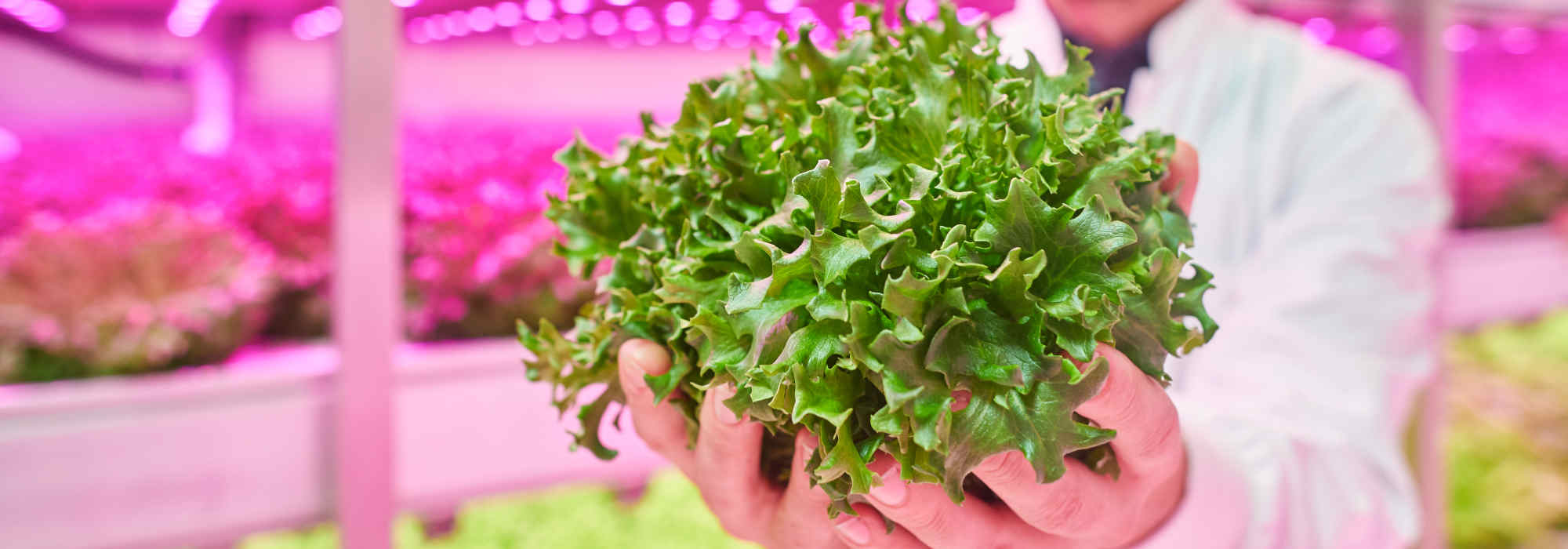
LED lighting system for vertical farming crops

4. Manage nitrates through lighting strategies

Nitrate concentration is another parameter affected by growing conditions. In certain leafy vegetables, lighting strategies can modify nitrogen metabolism and consequently nitrate accumulation in plant tissues.

This is particularly relevant to growers of lettuce, spinach, rocket and other leafy vegetables. Lighting should not be treated in isolation: final nitrate concentration also depends on nutrition, light intensity, photoperiod, variety and environmental conditions.

Available research shows that the relationship between LED spectrum and nitrate metabolism is complex, but confirms that light quality can be another control variable in enclosed growing environments. Frontiers in Plant Science reviews pre-harvest lighting strategies.

5. Improve quality without replacing the entire installation

A key advantage of adjustable LED lighting is flexibility. Different species or varieties can be grown in a vertical farm, with different lighting configurations established as required without physically replacing every luminaire.

This is particularly useful where production must adapt to different clients, seasons or varieties. The same infrastructure can serve different crops by changing intensity, photoperiod or spectral composition.

Neocultum offers horticultural lighting from various manufacturers and works with systems that adapt lighting to each installation. Explore Neocultum’s lighting brands and solutions to learn about technologies for different applications.

6. Optimise a vertical farm’s energy consumption

Lighting is a major element of energy consumption in vertical farming. The aim is not simply to deliver a large amount of light, but the right quantity and quality at each moment.

A dynamic strategy can adjust intensity as crop needs change, allowing different light levels according to development stage and crop objectives.

Energy efficiency should always be assessed alongside yield. Lower electricity use does not necessarily make sense if it substantially reduces production. The aim should be a balance between energy consumed, quantity produced and crop quality.

Recent vertical farming research is investigating this relationship between spectrum, production and energy efficiency. A 2026 study found differences in yield, quality and energy-use efficiency depending on the combination of LED spectrum and growing system. Read the study in BMC Plant Biology.

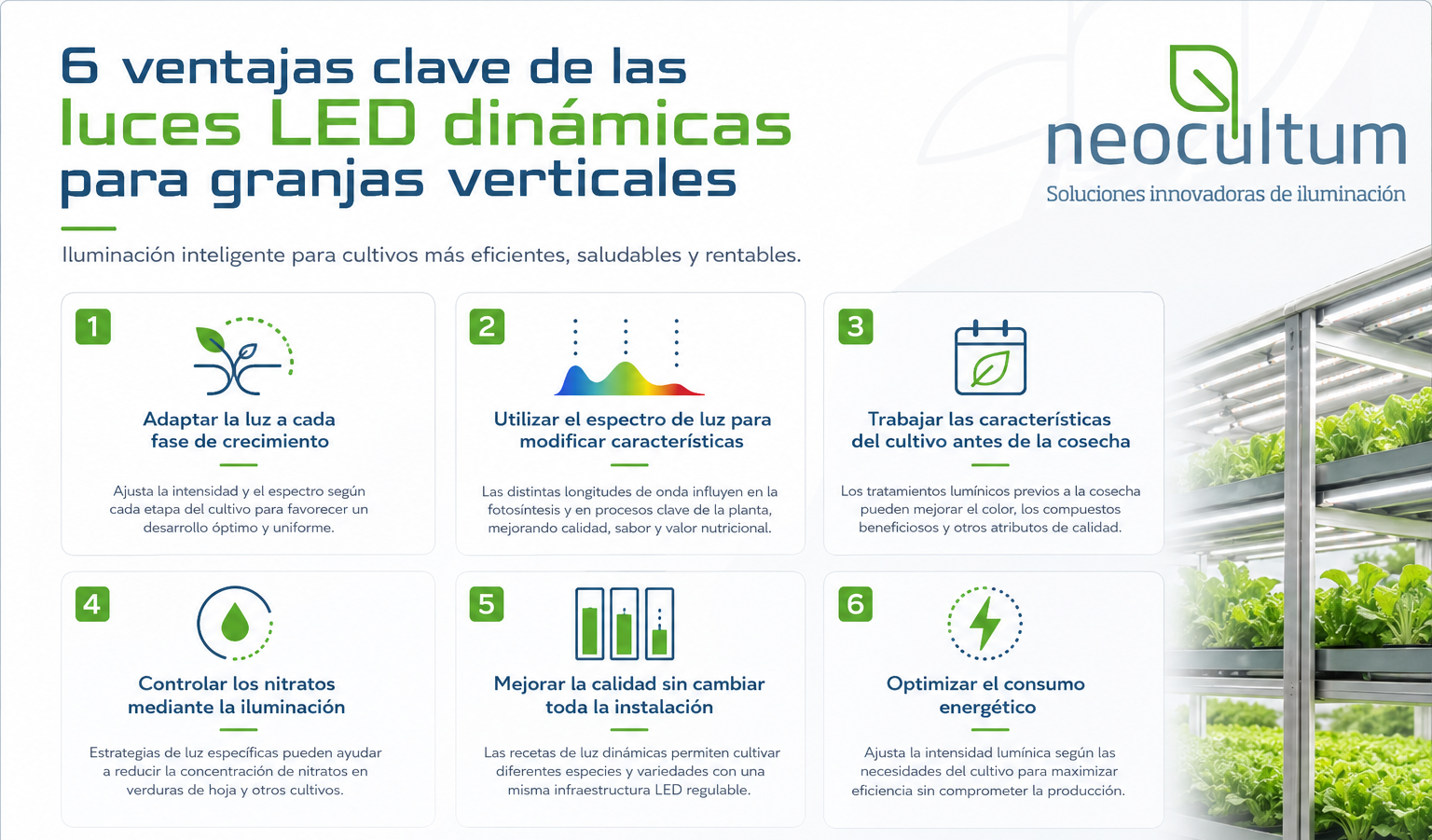
Six advantages of LED lights for vertical crops

Why are light recipes important in a vertical farm?

A crop light recipe is a planned combination of lighting parameters adapted to a crop at a particular time. Rather than thinking only about a luminaire, it involves a complete strategy considering intensity, spectrum, photoperiod and development stage.

This makes lighting a production tool. The aim is no longer simply to illuminate a plant, but to use light in a controlled way to help achieve specific agronomic and commercial results.

In a professional installation, recipes can form part of a control system that automatically changes lighting conditions. Current technology facilitates different scenarios and adjustments based on data gathered during cultivation.

From fixed lighting to intelligent lighting

Horticultural lighting is evolving towards increasingly controllable indoor growing systems. Modern LEDs offer efficiency and adjustability that enable much more precise strategies than conventional technologies.

For a vertical farm, this means lighting can become integrated into the production strategy. Instead of identical settings throughout the cycle, different scenarios can be planned for propagation, growth, development and the pre-harvest stage.

The challenge is determining the best strategy for each crop. No universal recipe produces identical results across all species and conditions. Variety, planting density, hydroponic system, temperature, CO₂, nutrition and other factors interact with lighting.

A vertical farming LED lighting project must therefore begin by analysing the installation and the grower’s objectives. Luminaires can then be selected, light distribution defined and a crop-specific control strategy established.

What is the future of dynamic LED grow lights?

Dynamic lighting research still has considerable scope. Studies increasingly examine how wavelengths interact with plant genetics, growth stage and environmental conditions in controlled growing facilities.

This opens the way to more specific strategies: growth-focused lighting during one stage, pre-harvest spectral changes, adjustments for particular quality attributes, or intensity changes to improve energy efficiency.

In future, combining sensors, control systems, artificial intelligence and crop models could allow installations to adjust lighting automatically using real plant and environmental data. Vertical farms could move beyond predetermined lighting programmes towards much more precise adaptive growing conditions.

At Neocultum, we develop LED lighting projects for horticulture and vertical farming, selecting professional solutions and adapting them to each installation. If you are considering vertical farming, indoor growing or hydroponic production, contact our team to assess your lighting requirements.