Full white light for growing: LED spectrum, efficiency and crop visibility
Category: Vertical farming
White grow light has become a widely discussed subject in technical horticulture, vertical farming and indoor cultivation. Many growers automatically associate white light with more natural lighting and therefore better plant results. From a growing perspective, however, the issue is more complex.
Plants do not interpret light as people do. Human eyes need a balanced combination of wavelengths to perceive light as white, whereas plants respond according to their physiology, development stage and crop objective.
Professional horticultural LED design should therefore ask more than whether light appears white. What matters is the spectrum plants receive, how they use it, the resulting yield and the energy needed to produce it.
What does white light mean in horticulture?
White light is not a single wavelength. It is a visual perception created by combining different parts of the visible spectrum. It can contain different proportions of blue, green, red and other wavelengths. Two luminaires that appear white may have very different spectral compositions.
The term white light alone therefore tells us little about plant response. Proper assessment requires spectral distribution, photon output, efficiency and the intensity reaching the canopy.
Plants do not need to see light as we do
Human eyes interpret the environment through colours, shapes and contrasts, making white lighting more comfortable for work. Plants instead use light as an energy source and a biological signal.
Some wavelengths actively support photosynthesis, while others influence architecture, leaf expansion, flowering, pigmentation or morphology. Light that appears unnatural to a person can therefore be perfectly functional for a crop.
Is white light essential for growing?
Not necessarily. Plants can develop correctly under spectra specifically designed for horticulture without the light appearing white to human eyes.
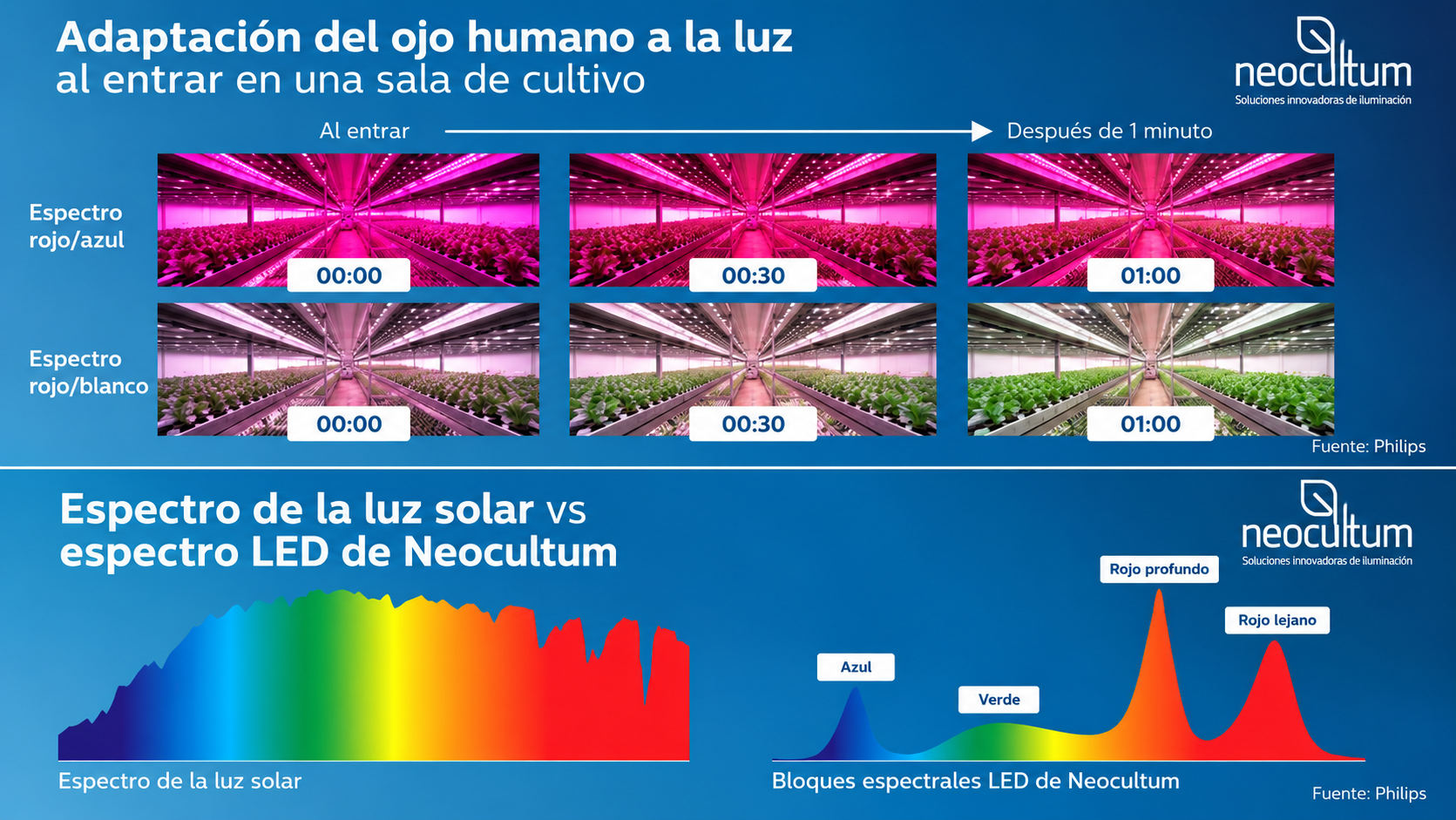
For years, professional installations have used red and blue combinations because both regions are important for plant development and can be produced efficiently by LEDs. Other colours are not useless: green light also contributes to crop responses and can benefit both plants and workers.
The question is which proportion of each spectral region suits the particular objective.
White light versus an optimised LED spectrum
The comparison should not be reduced to deciding which is universally better. An optimised spectrum can provide particular proportions of blue, red and other wavelengths to encourage a specific response.
White light makes human work easier and provides a more natural view. Both priorities can coexist: a recipe can contain enough green to improve crop visibility while retaining a spectrum designed for good photosynthetic efficiency.
The importance of red light
Red light is important in many horticultural lighting systems. Red LEDs can achieve high efficiency and produce many useful photons with relatively low electricity consumption.
Professional spectra therefore often contain a substantial red fraction. Using more red can be attractive when the objective is to maximise photons produced per unit of energy.
Blue light is important too
Blue is part of many horticultural spectra. Besides contributing to photosynthesis, it can influence morphology, leaf development and other physiological responses.
The appropriate quantity depends on species, variety, crop stage and commercial objective. The aim is not the maximum amount of one colour, but a balanced recipe.
What role does green light play?
Green light has long been considered less important, but this is oversimplified. Some green light can pass through upper canopy layers and reach deeper leaves.
For operators, green greatly improves natural colour perception. This helps inspect leaves, detect changes, assess crop colour and work more comfortably. A certain green proportion can therefore make sense without dominating the spectrum.
Good crop visibility also matters
Workers in vertical farms and indoor spaces need to observe plants continually. A red-and-blue-dominated spectrum can distort colour perception and hinder detection of abnormalities.
A white or green component facilitates visual inspection, leaf-damage identification, pest detection and assessment of general crop condition. Lighting design must therefore consider ergonomics and working conditions as well as plants.
White light and energy efficiency
Energy efficiency is fundamental in vertical farming and indoor growing. Lighting can account for a substantial share of electricity use, so small efficiency differences can significantly affect operating costs.
A broad-spectrum luminaire distributes energy across spectral regions. A horticulture-specific luminaire may concentrate more energy in particular wavelengths. Visually whiter light therefore does not necessarily mean greater crop efficiency.
Light appearance is not the only measure
A common mistake is judging a luminaire simply by its colour. Two apparently similar systems may differ greatly in efficiency, spectrum and photon output.
Professional horticulture benefits from technical parameters such as photosynthetic photon flux, system efficiency, spectral distribution and lighting uniformity. These enable more objective comparisons.
The light recipe must suit each crop
No spectrum is perfect for every plant. Lettuce needs can differ from strawberries, tomatoes, ornamentals and herbs, with differences even between varieties of the same species.
A professional strategy must consider the crop, genetics, development stage and final objective. At Neocultum, we work with horticultural LED solutions for crop- and production-system-specific strategies.
White light in vertical farms
Lighting control is especially important where plants depend entirely on artificial light. Photoperiod, intensity, spectrum and distribution can be precisely defined.
This permits a more precise recipe than in an environment dependent on sunlight. White light can be part of the overall strategy without being the sole design criterion.
The key is balancing growth, quality, human perception and energy efficiency.
Dynamic lighting: adapting the spectrum during the cycle
LED technology goes further: some installations can change spectrum and intensity at different stages. Plants need not receive an identical recipe from the start to harvest.
One stage may prioritise vegetative growth and another particular quality, morphology or colour characteristics. This enables more advanced strategies than simply choosing white or coloured light.
When is more white light useful?
White light is especially useful where frequent human inspection, visual comfort or rapid assessment of natural leaf and fruit colour are priorities.
This does not require exactly reproducing sunlight. A well-designed combination can provide sufficiently natural visibility without sacrificing efficiency.
When might a specific spectrum be better?
A specialised spectrum is useful when the main goal is energy performance or a particular crop response. The luminaire can concentrate more energy in specific spectral regions.
This makes lighting a precision tool. The challenge is balancing efficiency, plant response and operational needs.
Lighting must be part of an integrated strategy
Light is fundamental but does not act alone. Temperature, humidity, CO₂, water, nutrition, planting density and genetics also affect the crop.
Lighting design must form part of a complete growing recipe. Professional installations should seek the combination delivering the best overall result, rather than simply the most powerful luminaire.
The best light is not always the whitest
White light offers important benefits, particularly for human perception and working comfort. However, a completely white spectrum is not essential for healthy, productive crops.
Plants respond to different wavelengths, and LEDs enable spectra for specific objectives. The key is balancing energy efficiency, productivity, quality, ease of inspection and species-specific needs.
Instead of asking only whether a luminaire produces white light, assess its spectrum, photon output, distribution over plants and crop response. This turns LED lighting into a precision tool for modern horticulture.
If you are developing indoor growing, vertical farming or greenhouse production, explore Neocultum’s horticultural lighting solutions or contact our team to assess a solution for your installation.